Understanding the Legal Standards for Patentable Inventions
A patent is an intellectual property right granted by the United States government that allows inventors to exclude others from making, using, selling, offering for sale, or importing an invention into the United States. Under U.S. patent law, inventors receive legal protection in exchange for publicly disclosing how their invention works. Understanding the legal standards for patentable inventions is essential for entrepreneurs, engineers, startups, and creators seeking to protect and commercialize innovation.
A patent does not automatically protect every idea. The invention must satisfy specific legal requirements established by U.S. patent law.
— 35 U.S. Code § 154
Obtaining a patent can significantly increase the commercial value of an invention and provide leverage against competitors. However, many inventors misunderstand what qualifies for patent protection, which often leads to rejected applications or choosing the wrong type of intellectual property protection.
Utility Requirement for Patentability
One of the first legal standards for patentable inventions is utility. To qualify for a patent, an invention must be useful and provide a meaningful benefit. In practical terms, the invention must perform a functional purpose and deliver a real-world application.
For example, a machine that spins without accomplishing any practical function will generally not qualify for patent protection. However, if the spinning mechanism improves an existing technology or contributes to a useful process, the invention may become patentable.
ℹ️ Info: The USPTO evaluates whether an invention has a specific, substantial, and credible utility before approving a patent application.
An inventor should also understand that usefulness alone is not enough. Patent eligibility requires additional legal elements that distinguish genuine innovation from abstract concepts or naturally existing principles.
Categories That Are Generally Not Patentable
Several categories are commonly excluded from patent protection under U.S. law. These include tax strategies, human organisms, abstract ideas, natural phenomena, and laws of nature.
Although these exclusions may seem straightforward, patent law often applies them in a nuanced way. An invention may still qualify for protection if it incorporates one of these concepts into a practical and functional application.
For instance, gravity itself cannot be patented because it is a law of nature. However, a machine that strategically uses gravity as part of a mechanical process may still qualify for patent protection if the overall invention is novel and functional.
⚠️ Warning: Attempting to patent a pure abstract idea without a practical implementation will likely result in rejection by the USPTO.
Novelty and Non-Obviousness Requirements
In addition to utility, the legal standards for patentable inventions require novelty and non-obviousness. Novelty means the invention must be new and not previously disclosed anywhere in the world. Non-obviousness means the invention cannot simply be an obvious modification of existing technology to someone skilled in the relevant field.
An invention that combines known technologies in a predictable manner may fail the non-obviousness requirement. Patent examiners carefully review prior patents, publications, and public disclosures to determine whether the invention genuinely advances existing technology.
Critical Risks
- Publicly disclosing your invention before filing a patent application may negatively affect patent rights in certain jurisdictions.
Inventors should conduct a professional patent search before filing to evaluate existing prior art and reduce the risk of rejection.
Types of Patent Applications Available
Once an invention satisfies the legal standards for patentable inventions, inventors may pursue different types of patent applications depending on the nature of the innovation.
Utility Patents
Utility patents are the most common type of patent protection. They apply to processes, machines, manufactured articles, compositions of matter, and functional improvements of existing inventions.
A new manufacturing process, software-related invention, or medical device may qualify for utility patent protection if all legal requirements are met.
Design Patents
Design patents protect the ornamental appearance of a functional product rather than the product’s functional mechanics. One famous example is the classic contoured Coca-Cola bottle, whose distinctive appearance became legally protected.
ℹ️ Info: A design patent protects how a product looks, while a utility patent protects how it works.
Plant Patents
Plant patents are available for inventors or discoverers who create new plant varieties through asexual reproduction. These patents are less common but remain an important area of intellectual property protection in agriculture and biotechnology.
Patents vs. Trademarks vs. Copyrights
Many individuals incorrectly use the word “patent” when referring to other forms of intellectual property. Understanding these distinctions is critical when selecting the appropriate legal protection strategy.
A unique logo placed on a shirt is generally protected through trademark law, not patent law. Likewise, purely artistic creations such as paintings may qualify for copyright protection instead of design patent protection.
Because intellectual property law is highly technical, inventors should work closely with experienced legal counsel before filing any application.
Why Working With an Intellectual Property Attorney Matters
Determining whether an invention is patentable requires legal analysis, technical understanding, and familiarity with USPTO procedures. Even highly innovative products can encounter obstacles if applications are drafted incorrectly or filed prematurely.
An experienced intellectual property attorney can help evaluate patent eligibility, conduct prior art searches, prepare strong patent claims, and determine whether patents, trademarks, or copyrights provide the best protection strategy.
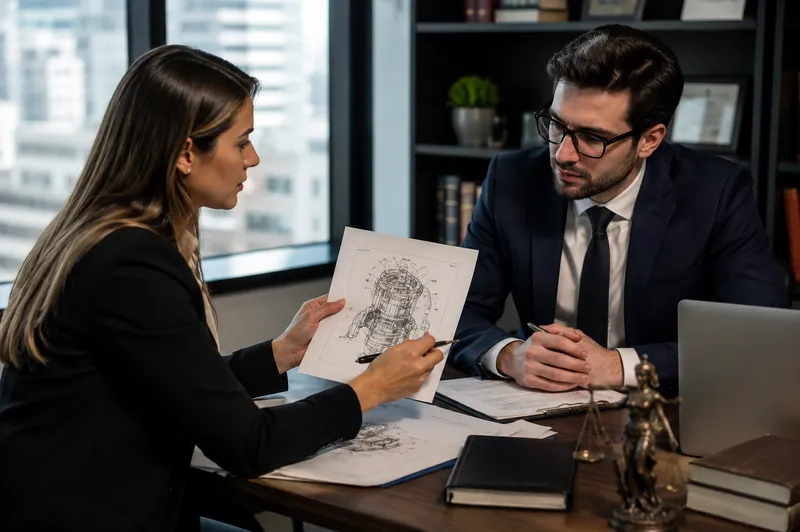
Strong patent applications are often built on detailed technical disclosures and carefully drafted legal claims.
The attorneys at Alcoba Law Group have experience assisting inventors with patents, trademarks, and copyrights across multiple industries. Whether you are protecting a new product, process, or brand identity, legal guidance can help reduce risks and improve long-term commercial protection.
Written by: David Sacasa Ⓒ 2021 Alcoba Law Group P.A.
Picture Credits: Miri Paez Bolet.
Reviewed by: Ruben Alcoba