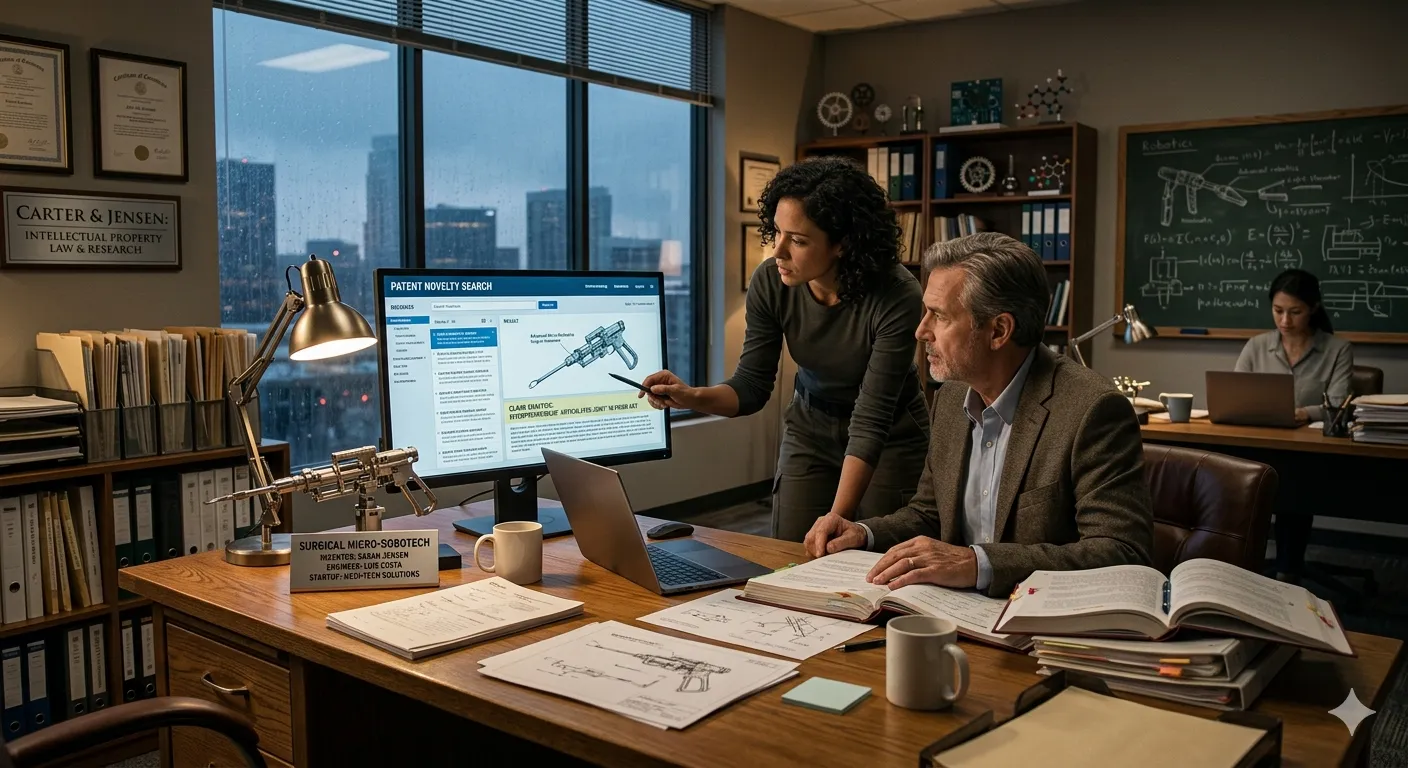
Inventors, engineers, and startup founders frequently hear that conducting a prior art search patent USA is one of the most important preliminary steps before investing in a patent application. Even so, many applicants still skip this stage or rely exclusively on generic online searches that fail to reflect the complexity of the U.S. patent system. The result is often a patent filing strategy disconnected from the actual state of the art and applications with a low probability of allowance before the USPTO.
A patent application may appear innovative from a commercial perspective while still lacking novelty under U.S. patent law.
A structured prior art review allows applicants to understand whether an invention truly presents a technically distinguishable solution capable of supporting enforceable patent claims.
Why Prior Art Searches Matter in the U.S. Patent System
Under U.S. patent law, an invention must be both novel and non-obvious in light of existing technology and publications. Commercial value alone is insufficient. The USPTO examiner will compare the application against earlier patents, patent publications, scientific references, and other technical disclosures to determine whether the claimed invention satisfies patentability requirements.
ℹ️ Info: The USPTO evaluates novelty and inventive step based on previously available public disclosures worldwide.
A prior art search anticipates part of the examiner’s analysis by identifying documents that may affect the patentability of the invention before significant resources are invested in filing and prosecution.
Through a properly conducted search, it becomes possible to:
- identify substantially similar or identical solutions;
- evaluate how the same technical problem has already been addressed;
- assess whether there is room for strategically drafted claims with commercially meaningful scope;
- determine whether technical differentiation actually exists.
Without this preliminary assessment, applicants often proceed with filing “blind,” increasing the likelihood of office actions, major amendments, restrictions, or final rejections.
Critical Risks
- Filing without understanding the existing patent landscape can lead to weak claims, wasted prosecution costs, and reduced portfolio value.
What a Prior Art Search Patent USA Actually Includes
A professional prior art search is not limited to keyword matching on search engines. It is a structured investigation performed through specialized patent databases using classifications, technical terminology variations, synonyms, and combinations of inventive features.
The process generally includes analysis of:
- granted U.S. patents;
- published U.S. patent applications;
- international patent documents;
- non-patent literature, including scientific articles, technical reports, and industry standards when relevant.
⚠️ Warning: Many critical prior art references are missed when searches rely only on obvious keywords or consumer search engines.
The legal interpretation of the identified documents is just as important as locating them. A technically similar reference may or may not destroy novelty depending on how the claims are drafted and how the disclosure is interpreted under patent law standards.
Best Timing to Conduct a Prior Art Search
The ideal moment to conduct a prior art search is before filing either a provisional or non-provisional patent application. In practice, the invention should already be sufficiently defined from a technical standpoint, even if future refinements remain possible.
By performing the search early, inventors and companies can:
- adjust claim language around truly novel elements;
- redefine the intended scope of protection;
- identify whether continuation of the project is commercially and legally justified;
- avoid investing in patent filings with limited strategic value.
ℹ️ Info: Early-stage patent analysis often helps startups allocate capital more efficiently within their intellectual property strategy.
When applicants skip this stage, the examination process frequently becomes reactive rather than strategic. Examiners may later cite prior art that could have been identified and addressed before filing.
Economic and Strategic Risks of Skipping the Search
Patent filings in the United States involve substantial legal, technical, and governmental costs. Forgoing a prior art search increases the risk that these investments will produce little or no enforceable protection.
A well-executed prior art search serves both as a risk filter and as a strategic roadmap. In some cases, it confirms that meaningful protection is achievable with carefully drafted claims. In others, it reveals that the proposed invention is already too close to existing disclosures, allowing the applicant to redirect resources toward stronger innovations or alternative business strategies.
⚠️ Warning: Startups that file patents without prior art analysis may unintentionally disclose commercially valuable concepts without obtaining meaningful exclusivity.
The prior art search should therefore be viewed not as an optional expense, but as a central component of sophisticated intellectual property planning. Inventors, engineers, and technology companies that rely on experienced patent counsel during this phase generally achieve greater certainty when defining filing strategies, allocating R&D budgets, and building patent portfolios aligned with long-term commercial objectives.
Strong patent portfolios are usually built through strategic selection and claim positioning, not by filing every invention indiscriminately.
— USPTO patent examination framework and international patentability standards.